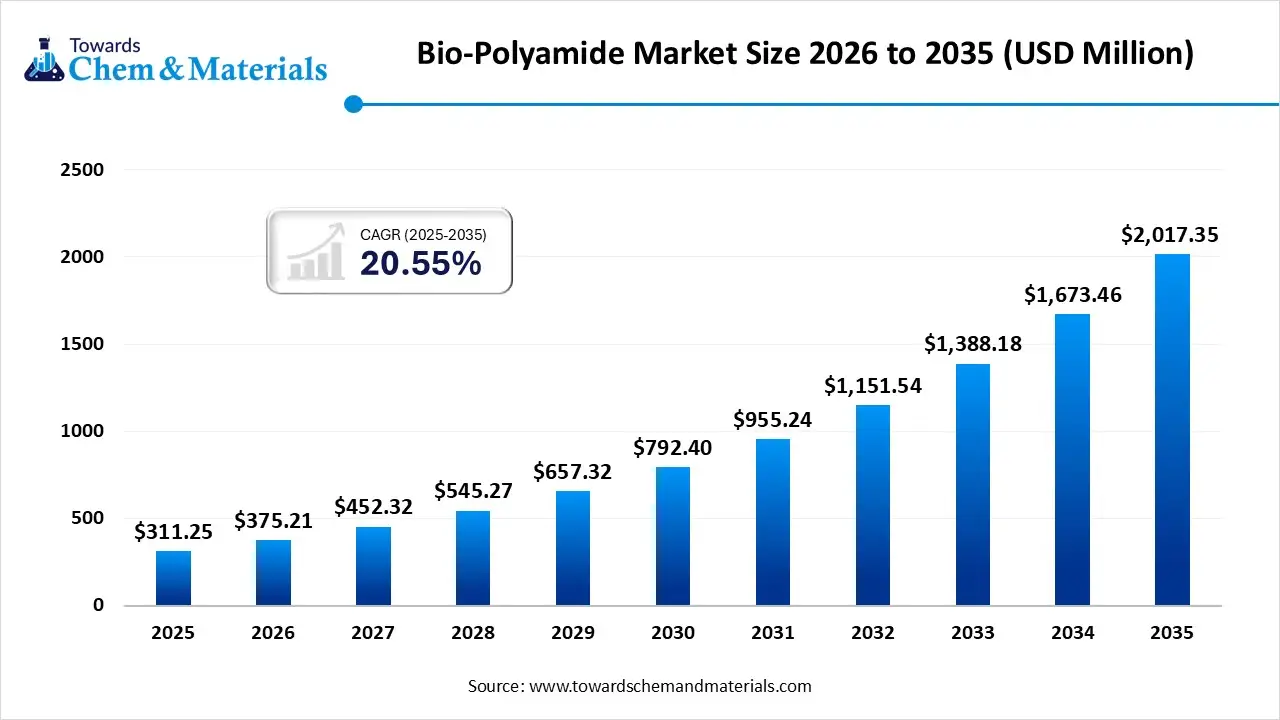
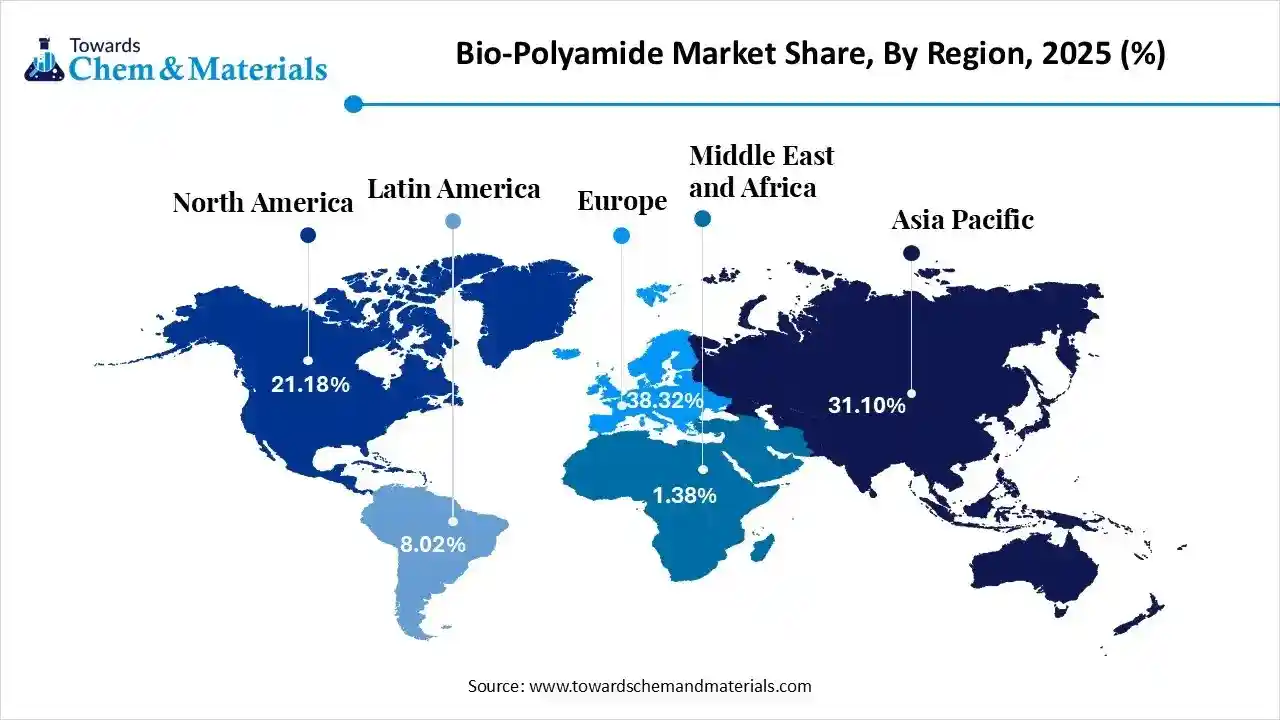
Ottawa, Feb. 03, 2026 (GLOBE NEWSWIRE) -- The global bio-polyamide market size was estimated at USD 311.25 million in 2025 and is expected to increase from USD 375.21 million in 2026 to USD 2,017.35 million by 2035, growing at a CAGR of 20.55%. Europe dominated bio-polyamide market with the largest volume share of 38.72% in 2025 The market is driven by a rising focus on sustainable materials and strict government regulation promoting bio-based materials. A study published by Towards Chemical and Materials, a sister firm of Precedence Research.
Download a Sample Report Here@ https://www.towardschemandmaterials.com/download-sample/5627
What is Bio-Polyamide?
The bio-polyamide is a polymer resulting from a renewable biological source, agricultural waste, which ultimately lowers the carbon footprint and greenhouse gas emissions. It offers superior chemical resistance and lower moisture absorption, which is driving its application in the automotive, textile, electronics, and medical sectors.
Bio-Polyamide Market Report Highlights
- The Europe dominated the global bio-polyamide market with the largest volume share of 36.15% in 2025.
- By product, the PA-66 segment dominated the market with the largest revenue share of over 51.98% in 2025.
- By application, the engineering plastics segment dominated the market and accounted for the largest share of 68.89% in 2025.
- By end use, the automotive segment dominated the market and accounted for the largest share of over 36.55% in 2025.
Bio-Polyamide Market Report Scope
| Report Attribute | Details |
| Market Size in 2026 | USD 375.21 Million |
| Expected Size by 2035 | USD 2,017.35 Million |
| Growth Rate from 2026 to 2035 | CAGR 20.55% |
| Base Year of Estimation | 2025 |
| Forecast Period | 2026 - 2035 |
| Dominant Region | Europe |
| Segment Covered | By Product, By Application, By End-use, By Region |
| Key Companies Profiled | Evonik Industries AG, Huntsman International LLC, LANXESS, BASF SE, UBE Corporation, INVISTA, DOMO Chemicals GmbH, Arkema, Asahi Kasei Corporation, Honeywell International Inc., DSM, TORAY INDUSTRIES, INC., Radici Partecipazioni SpA, DuPont, Solvay, ZIG SHENG INDUSTRIAL CO., LTD, Quadrant Group Limited, LEALEA ENTERPRISE CO., LTD., EMS-CHEMIE HOLDING AG |
Request Research Report Built Around Your Goals: sales@towardschemandmaterials.com
Immediate Delivery Available | Buy This Premium Research Report@ https://www.towardschemandmaterials.com/checkout/5627
Key Applications of Bio-Polyamide:
- Automotive Components: They are used for under-the-hood parts like fuel lines and engine covers due to their high thermal stability and chemical resistance.
- Textiles and Apparel: Bio-polyamide fibers are used in activewear and outdoor gear because they offer excellent durability, moisture-wicking, and a reduced environmental footprint.
- Electronics and Electrical Devices: These materials provide essential electrical insulation and heat resistance for connectors, circuit boards, and consumer gadget casings.
- Packaging Solutions: They serve as a biodegradable or recyclable alternative for flexible and rigid packaging, using strong barrier properties to preserve food and pharmaceuticals.
- Medical Devices: Because of their biocompatibility and strength, they are used in surgical sutures, catheters, and various medical implants.
- Industrial Equipment: They are employed in heavy-duty machinery components like pumps, valves, and gears, where high wear resistance and durability are required.
What Are Major Trends in the Bio-Polyamide Market?
- Shift Towards Circular Economy: The industry is focusing on chemical recycling technologies like microwave-based recycling to ensure bio-based materials remain within a closed-loop system.
- Strict Environmental Regulations: The trend is driven by a focus on reducing greenhouse gas emissions that reinforcing manufacturers to adopt low-carbon materials by promoting various national grants and initiatives.
- Supply Chain Collaboration: The market player is forming a strategic partnership with bio-based feedstock producers and a joint venture to accelerate commercialization.
For more information, visit the Towards Chemical and Materials website or email the team at sales@towardschemandmaterials.com| +1 804 441 9344
Immediate Delivery Available | Buy This Premium Research Report@ https://www.towardschemandmaterials.com/checkout/5627
Bio-Polyamide Market Dynamics
Driver
Demand in the Automotive Industry
The demand for automotive lightweight components is increasing to improve fuel efficiency and reduce emissions. The bio-polyamides used in cooling systems, battery casings, and wire harnesses offer thermal stability and a high strength-to-weight ratio, especially in electric vehicles that pushing the market towards adoption.
Restraints
Feedstock Volatility
Their reliance on agricultural raw materials make supply chain inclined to climatic conditions and agricultural uncertainties, leading to price volatility in raw material procurement and potential shortages that restrain the adoption of the bio-polyamide industry.
Opportunity
Emerging 3D Printing in Healthcare Solutions
The massive opportunity in personalised healthcare solutions due to their biocompatibility and ability to withstand sterilisation, which is bio-polyamide used in orthopaedic pins, implants, bone regeneration, and drug-delivery systems. While using 3D printing technologies, including 3D-printed surgical guides and drug-eluting scaffolds that allow for patient-specific solutions.
Bio-Polyamide: Data-driven today, Innovation-driven tomorrow
Artificial intelligence is transforming the industry by driving material discovery, optimizing biological manufacturing, and automating quality control. The predictive maintenance reduced downtime, while generative AI enables the creation of novel enzymes for non-natural chemical reactions by optimizing production and high-performance materials. Additionally, advanced simulations are driving atomic-level interactions to stabilize bio-nylons at high temperatures.
Bio-Polyamide Market Segmentation Insights
Product Insights
How Did the PA-66 Segment Dominates the Bio-Polyamide Market?
The PA-66 segment dominated the market with largest share due to its thermal stability, strength, and resistance. The market is driven by automotive and electronics, and uses bio-PA-66 for demanding parts like under-the-hood components and fuel lines. Its lower moisture absorption and wear resistance make it ideal for replacing metal and plastics in lightweighting to improve fuel efficiency and cut emissions. Overall, PA-66 established supply chains and performance keeps it dominant.
The PA-6 segment projected to grow fastest during the forecast period. By offering a versatile, cost-effective alternative to petroleum resins. Its ease of processing and high strength allow it to replace nylon without costly equipment changes. As industries shift towards sustainability, bio-PA-6 is preferred for textiles and automotive parts needing durability and heat resistance. Its compatibility with circular economy initiatives gives it a competitive edge, positioning it to capture new demand as brands adopt more eco-friendly materials.
Application Insights
Which Application Segment Dominates the Bio-Polyamide Market?
The engineering plastics segment maintains its market dominance, supporting industrial decarbonization with structural integrity and thermal resistance. Bio-polyamides replace metals and petroleum polymers in harsh environments, boosting the demand of this segment in automotive lightweighting and electronics needing flame-retardant, bio-consistent housings. They serve high-tensile and chemical durability demands that enable manufacturers to meet sustainability goals without sacrificing safety or durability, making it a key priority in the global market.
The fiber segment offers significant growth during the projected period, fueled by a push to decarbonize textiles. Brands in apparel, sportswear, and industrial sectors are replacing traditional nylon with bio-derived alternatives to meet sustainability and carbon-neutrality goals. Technical applications like tire cords and automotive fabrics also drive growth, requiring durability and elasticity. As consumer focus shifts to circular consumption, this segment offers renewable lifecycle benefits without compromising high-speed mass production, positioning it for the fastest growth in bio-synthetics.
End Use Insights
How did the Automotive Segment Dominate the Bio-Polyamide Market?
The automotive segment is maintaining its leadership, driving the adoption of renewable polymers. The surge for lightweight solutions to boost fuel efficiency and EV range, using bio-polyamides as replacements for heavier metal parts driving its expansion. These materials offer thermal stability, chemical resistance, and impact strength for sensitive automotive components. As emission standards tighten, using bio-resins helps reduce lifecycle carbon without sacrificing safety, making automotive the key source and innovation driver.
The textile segment is experiencing the fastest growth in the market during the projected period, propelled by sustainable fashion and circular materials. The leading brands are shifting from petroleum synthetics to bio-based nylons for activewear, home furnishings, and industrial fabrics due to environmental and durability demands. The advancement in fiber spinning technology enables high-speed production with these bio-resins, making the textile industry the main growth area, transforming sustainable fiber standards.
Regional Insights
How did Europe dominate the Bio-Polyamide Market?
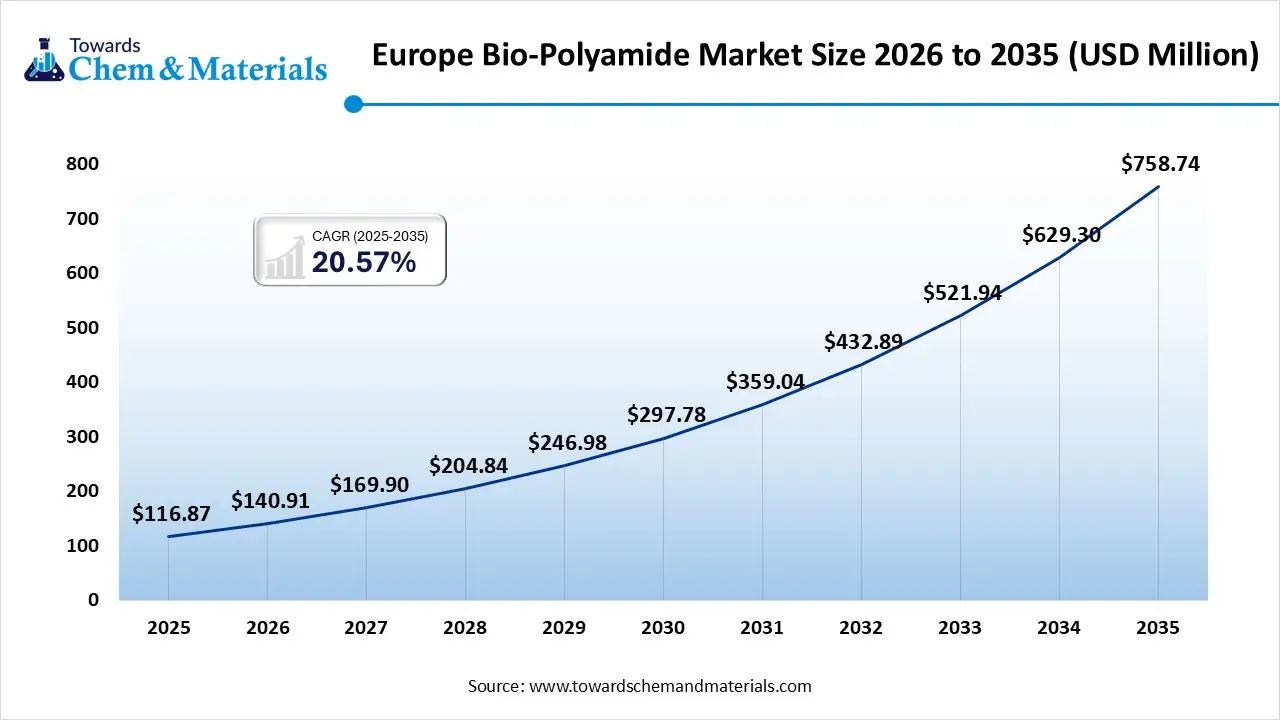
The Europe bio-polyamide market is expected to increase from USD 116.87 million in 2025 to USD 758.74 million by 2035, growing at a CAGR of 20.57% throughout the forecast period from 2025 to 2034. Europe leads in the market due to strict regulation, advanced circular economy infrastructure, and a strong chemical engineering tradition. Its leadership is supported by initiatives that enforce stringent carbon border taxes and bio-content thresholds. Europe focuses on discouraging petroleum use and encouraging sustainability. Manufacturers are leveraging R&D, high-grade polyamides, and meeting safety standards for the automotive and aerospace sectors.
European consumers prioritize traceability and lifecycle transparency, creating a market ready to invest in bio-polyamides certified with ISCC PLUS and aligned with ESG goals, fostering ongoing innovation and implementation.
Germany Bio-Polyamide Market Trends
Germany's market is gaining momentum as manufacturers increasingly adopt sustainable alternatives to traditional nylon in automotive, electronics, and consumer goods to meet environmental and regulatory pressures for reduced carbon footprints. Demand is driven by strong automotive sector interest in lightweight, high-performance biobased polymers for under-the-hood components, interior parts, and cable ties, aligning with broader electrification and fuel-efficiency goals.
Why is North America the Fastest-Growing Region in the Bio-Polyamide Industry?
The North American market is growing rapidly, driven by a shift toward high-performance, low-carbon materials in automotive and textiles. The major manufacturers are integrating bio-based monomers into existing supply chains to meet ESG mandates and USDA BioPreferred standards. The expansion in electric mobility, driving demand for lightweight, thermally stable bio-nylons for batteries and electrical parts, has transformed these polymers into essential engineering materials.
A rising consumer preference for circular products additionally promotes the adoption of eco-friendly bio-polyamides that offer durability by reducing environmental impact.
Canada Bio-Polyamide Market Trends
Canada's market is growing as industries seek sustainable alternatives to traditional petroleum-based nylons, driven by increasing environmental awareness and demand for lower-carbon footprint materials. The automotive, consumer goods, and electronics sectors are key adopters, using bio-polyamides for lightweight, high-performance parts that support fuel efficiency and recyclability goals.
Recent Breakthroughs in the Bio-Polyamide Market
- In April 2025, BASF SE and TE Connectivity announced a strategic collaboration to produce an automotive connector with components made using Ultramid Ccycled polyamide, a chemical recycling solution derived from post-consumer plastic waste. This collaboration focuses on sustainable solutions in the automotive sector.
https://www.basf.com/in/en/media/news-releases/asia-pacific/2025/04/apac-25-33
More Insights in Towards Chemical and Materials:
Bio-polyols Market Size to Hit USD 21.47 Bn by 2035
Bioplastic Textiles Market Size to Hit USD 34.53 Billion by 2035
Bioplastic Compounding Market Volume to Hit 12.54 Million Tons 2035
Bioethanol Market Volume to Surpass 138.23 Million Tons by 2035
Biogas Market Size to Hit USD 265.60 Bn by 2035
Bioplastics in Diagnostic Devices Market Size to Hit USD 879.46 Million by 2035
Bioplastics In Medical Devices Market Size to Surpass USD 6.73 Billion by 2035
Europe Biopolymers Market Size to Surge USD 18.23 Billion by 2035
U.S. Biopolymers Market Size to Worth Around USD 22.16 Bn by 2035
Europe Biodegradable Plastics Market Size to Reach USD 39.50 Bn by 2035
U.S. Bioplastics Market Size to Reach USD 21.84 Bn by 2035
Europe Bioplastics and Biopolymers Market Size to Reach USD 34.37 Bn by 2035
U.S. Bioplastics and Biopolymers Market Size to Surpass USD 34.37 Bn by 2035
Asia Pacific Biopolymers Market Size to Worth USD 26.39 Bn by 2035
Agricultural Biologicals Market Size to Hit USD 68.36 Bn by 2035
Biopolymer Coatings Market Size to Reach USD 109.08 Bn by 2035
Biohydrogen Market Size to Surpass USD 157.80 Million by 2035
U.S. Biofuels Market Size to Surpass USD 109.65 Billion by 2035
Biofuels Market Size to Reach USD 326.99 Billion by 2035
Advanced Biofuels Market Size to Surpass USD 3,004.03 Bn by 2035
Biofertilizer Market Size To Hit USD 11.08 Billion by 2035
U.S. Biopolypropylene Market Size to Hit USD 698.38 Mn by 2034
Bio-Based Polypropylene Market Size to Hit USD 6,977.54 Mn by 2034
Asia Pacific Biofuels Market Size to Surge USD 70.22 Billion by 2034
U.S. Biodiesel Market Size to Surge USD 24.63 Billion by 2034
Top Market Players in Bio-Polyamide Market & Their Offerings:
Tier 1:
- DuPont: Produces the Zytel RS line, featuring long-chain polyamides like PA1010 and PA610 derived from castor oil for automotive and electronic applications.
- Huntsman International LLC: Provides specialty polyamide-based resins and curing agents used in high-performance adhesives, coatings, and composite materials.
- LANXESS: Manufactures Durethan BLUE, a range of PA6 compounds that utilize a mass-balance approach to incorporate bio-based or recycled raw materials.
- Evonik Industries AG: Markets the VESTAMID Terra series, which includes PA1010 and PA610 grades sourced from renewable castor bean oil.
- Solvay: Offers bio-based nylon solutions under the Technyl brand, focusing on high-performance engineering plastics for sustainable textiles and consumer goods.
- UBE Corporation: Produces bio-derived nylon grades that emphasize high heat resistance and durability for demanding industrial and automotive parts.
- INVISTA: Focuses on sustainable PA66 resins and intermediates, utilizing research and development to improve the environmental footprint of industrial textiles.
- BASF SE: Offers Ultramid S Balance (PA610), a partially bio-based polyamide derived from castor oil known for its high chemical resistance and low moisture absorption.
Tier 2:
- DOMO Chemicals GmbH
- Honeywell International Inc.
- Radici Partecipazioni SpA
- DSM
- TORAY INDUSTRIES, INC.
- Arkema
- Asahi Kasei Corporation
- ZIG SHENG INDUSTRIAL CO., LTD
- Quadrant Group Limited
- LEALEA ENTERPRISE CO., LTD.
- EMS-CHEMIE HOLDING AG
Bio-Polyamide Market Report Segmentation
This report forecasts revenue growth at global, regional, and country levels and provides an analysis of the latest industry trends in each of the sub-segments from 2019 to 2035. For this study, Towards Chemical and Materials has segmented the global Bio-Polyamide Market
By Product
- PA-6
- PA-66
- Specialty Polyamides
By Application
- Fiber
- Engineering Plastics
By End-use
- Textile
- Automotive
- Film & Coating
- Consumer Goods
- Industrial
- Electrical & Electronics
- Others
By Region
North America:
- U.S.
- Canada
- Mexico
- Rest of North America
South America:
- Brazil
- Argentina
- Rest of South America
Europe:
- Western Europe
- Germany
- Italy
- France
- Netherlands
- Spain
- Portugal
- Belgium
- Ireland
- UK
- Iceland
- Switzerland
- Poland
- Rest of Western Europe
- Eastern Europe
- Austria
- Russia & Belarus
- Türkiye
- Albania
- Rest of Eastern Europe
Asia Pacific:
- China
- Taiwan
- India
- Japan
- Australia and New Zealand,
- ASEAN Countries (Singapore, Malaysia)
- South Korea
- Rest of APAC
MEA:
- GCC Countries
- Saudi Arabia
- United Arab Emirates (UAE)
- Qatar
- Kuwait
- Oman
- Bahrain
- South Africa
- Egypt
- Rest of MEA
Immediate Delivery Available | Buy This Premium Research Report@ https://www.towardschemandmaterials.com/checkout/5627
About Us
Towards Chemical and Materials is a leading global consulting firm specializing in providing comprehensive and strategic research solutions across the chemical and materials industries. With a highly skilled and experienced consultant team, we offer a wide range of services designed to empower businesses with valuable insights and actionable recommendations.
Our Trusted Data Partners
Towards chem and Material | Precedence Research | Statifacts | Towards Packaging | Towards Healthcare | Towards Food and Beverages | Towards Automotive | | Nova One Advisor | Nutraceuticals Func Foods | Onco Quant | Sustainability Quant | Specialty Chemicals Analytics | TCM Blog
For Latest Update Follow Us: https://www.linkedin.com/company/towards-chem-and-materials/
USA: +1 804 441 9344
APAC: +61 485 981 310 or +91 87933 22019
Europe: +44 7383 092 044
Email: sales@towardschemandmaterials.com
Web: https://www.towardschemandmaterials.com/