Global Coffee Shop Market to Reach USD 290.23 Billion by 2032 as Frequency-Led Consumption, Franchise Economics, and Pricing Power Redefine Profit Pools: Maximize Market Research
PR Newswire
PUNE, India, Jan. 30, 2026
PUNE, India, Jan. 30, 2026 /PRNewswire/ -- The Global Coffee Shop Market is no longer expanding because the world is drinking substantially more coffee. It is expanding because how often coffee is consumed, where it is consumed, and how it is monetized have fundamentally changed—reshaping profit pools across the global café ecosystem.
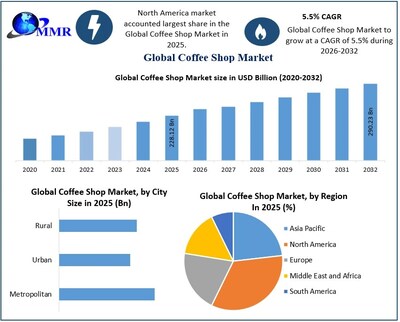
According to Maximize Market Research, the Global Coffee Shop Market was valued at USD 228.12 Billion in 2025 and is projected to reach USD 290.23 Billion by 2032, growing at a CAGR of 3.5% during the forecast period.
Beneath this steady growth lies a structural re-engineering of demand frequency, supply risk, unit economics, and franchise scalability, which is separating sustainable winners from structurally fragile operators.
Get Full PDF Sample Copy of Report: (Including Full TOC, List of Tables & Figures, Chart) @ https://www.maximizemarketresearch.com/market-report/global-coffee-shop-market/113030/
Executive Snapshot — Analyst Interpretation
Dimension | What the Data Reveals |
Market Growth Type | Frequency-led, not volume-led |
Core Revenue Engine | Footfall × ticket size × occasions |
Supply Exposure | Concentrated coffee production & volatility |
Margin Pressure | Raw coffee, labor, urban real estate |
Profit Pools | Branded chains & franchise networks |
Structural Losers | Independent, price-taking cafés |
High-Value Regions | North America, Europe |
High-Expansion Regions | Asia-Pacific, Middle East |
Coffee shops are no longer beverage outlets; they are high-frequency monetization platforms built on habit, location, and pricing power.
Why the Global Coffee Shop Market Matters Now
The market sits at the intersection of urban lifestyle shifts, hybrid work culture, and scalable retail economics.
Three structural forces are redefining the industry:
- Habitual, out-of-home consumption replacing occasional café visits
- Premiumization and food attachment expanding average ticket sizes
- Franchise-led expansion enabling rapid geographic scale with asset-light models
For CEOs, franchisors, and investors, the Global Coffee Shop Market is no longer a demand question—it is a capital allocation and execution discipline question. Expansion decisions now hinge on store-level economics, rent resilience, pricing elasticity, and repeat-consumption density. Brands that fail to design for these variables risk scaling revenue without scaling profitability. It is "Who can monetize frequency profitably despite volatile input costs?"
Demand Reality: Consumption Frequency vs Coffee Volume
Global coffee consumption (beans) has grown steadily—but coffee shop revenues have outpaced raw coffee demand. In mature urban markets, out-of-home coffee consumption accounts for over half of total coffee spending, driven primarily by repeat weekday visits rather than incremental consumer additions.
Analyst interrogation shows:
- Growth is driven by repeat visits, not new drinkers
- Urban consumers increasingly treat cafés as daily routines (work, meetings, social space)
- One consumer visiting 4–5 times per week creates exponentially more value than multiple occasional users
The coffee shop market monetizes habits, not cups sold.
Get Insightful Data on Regions, Market Segments, Customer Landscape, and Top Companies (Charts, Tables, Figures and More) -https://www.maximizemarketresearch.com/market-report/global-coffee-shop-market/113030/
Demand–Supply Mismatch: Coffee Shops vs Global Production
While cafés operate downstream, their cost base remains exposed to global coffee production concentration. With raw coffee costs representing less than 10% of the final beverage price, margin outcomes are determined more by pricing power and location economics than by commodity exposure alone.
- Over 60% of global coffee production is concentrated in Brazil and Vietnam
- Climate variability and sustainability compliance are increasing input price volatility
- Raw coffee price shocks are external and uncontrollable for café operators
Strategic implication:
- Branded chains pass costs forward through pricing and loyalty
- Independent cafés absorb margin erosion or lose competitiveness
Pricing power—not sourcing—determines survivability.
Store-Level Economics: Where Profitability Is Actually Decided
Coffee shop success is determined at the unit level, not the market level. Analyst assessment indicates that metro-located branded coffee shops generate up to 2.5–3× higher annual revenues per outlet compared to non-metro locations, despite materially higher rental costs.
Analyst assessment indicates:
- Average store revenues vary 2.5–3× between metro and non-metro locations
- Franchise formats reach operational breakeven faster due to standardized procurement and menus
- Independent cafés face longer payback cycles due to rent sensitivity and limited pricing power
In coffee retail, scalability exists only when unit economics survive rent cycles.
Footfall × Ticket Size × Occasion — The Revenue Engine
Food attachment and premium beverages can increase per-visit ticket size by 30–40%, materially improving unit-level profitability. Coffee shop revenue growth follows a three-lever model:
Lever | Strategic Meaning |
Footfall | Location quality & brand pull |
Ticket Size | Premium beverages + food attach |
Occasion | Morning, workday, evening usage |
Analyst interpretation:
- Morning & workday occasions drive volume
- Evening & social occasions drive margin
- Food attachment significantly increases per-visit value
Winning brands expand occasions, not just outlets.
Immediate Delivery Available | Buy this Research Report (Insights, Charts, Tables, Figures and More) - https://www.maximizemarketresearch.com/checkout/113030/
Real Estate & Rental Economics: The Hidden Constraint
Coffee is fundamentally a real-estate-anchored business.
- High-street and mall locations command premium rents
- Rent-to-revenue ratios determine survivability more than beverage pricing
- Drive-thru and compact formats improve economics in mature markets
Brands that design formats around rent economics outperform those chasing visibility alone.
Segment Economics: Where the Market Makes Money
By Business Model
Segment | Economic Role |
Branded Coffee Chains | Scale, pricing power, loyalty |
Franchise-Led Cafés | Fastest expansion, asset-light |
Independent Cafés | Experience-driven, margin-constrained |
Premium / Specialty Cafés | Highest per-store margins, limited scale |
Scale protects downside; premium protects upside.
By Format & Experience Model
- Specialty Coffee Shops: Lower volumes, highest ticket size and margins, concentrated in metros
- Mass-Market Coffee Shops: Volume-driven, price-sensitive, margin-constrained
- Drive-Thru & Compact Formats: Faster throughput, improving economics in mature markets
- Experience-Led Cafés: Higher dwell time, stronger food and merchandise attachment
Format strategy increasingly determines profitability more than menu strategy.
Regional Structure: Volume vs Value
- North America: Margin and pricing anchor
- Europe: Café culture, sustainability premium
- Asia-Pacific: Fastest store-count expansion
- Middle East & Latin America: Emerging lifestyle adoption
Emerging regions add stores; mature regions define profitability benchmarks.
Digital, Loyalty & Subscription — Margin Stabilizers
Global leaders increasingly rely on:
- Mobile ordering and prepaid wallets
- Loyalty programs driving repeat traffic
- Subscription models smoothing demand volatility
This creates predictable cash flows, better demand forecasting, and pricing resilience.
Digital ecosystems convert volatile daily consumption into recurring revenue.
Failure Risk Analysis: Why Most Coffee Businesses Don't Scale
Industry reality shows:
- A high share of independent cafés struggle beyond early years
- Common failure drivers:
- Poor location economics
- Inability to pass cost inflation
- Weak brand pull and repeat traffic
Franchise and branded chains survive because they:
- Spread risk across networks
- Standardize procurement
- Monetize loyalty at scale
Coffee is easy to enter, extremely hard to scale.
Competitive Dominance: Why Global Chains Keep Winning
The competitive gap is widening between data-driven, franchise-scalable global chains and cost-exposed independent cafés, with the former consolidating market share while the latter face structural margin compression. Chains such as Starbucks, Costa, Dunkin', McCafé, Tim Hortons, and Luckin Coffee dominate because they control:
- Procurement leverage
- Store standardization
- Digital data & loyalty ecosystems
- Franchise rollout speed
Independent cafés compete on ambience—brands compete on economics.
Analyst Perspective
"The Global Coffee Shop Market is not growing because people drink more coffee, but because they drink it more often, outside the home, and at premium prices," said a Senior Industry Analyst at Maximize Market Research.
"Brands that control frequency, pricing power, and franchise scalability will capture disproportionate value through 2032."
Access full, consulting-grade intelligence on the Global Coffee Shop Market (2025–2032) - https://www.maximizemarketresearch.com/market-report/global-coffee-shop-market/113030/
Why This Research Drives Decisions
The Global Coffee Shop Market report by Maximize Market Research is built for:
- Franchise and expansion planning
- Investment and entry evaluation
- Competitive benchmarking
- Pricing & positioning strategy
- Risk assessment under cost volatility
Related Reports:
Roasted Coffee Market - https://www.maximizemarketresearch.com/market-report/roasted-coffee-market/220786/
Coffee Machine Market - https://www.maximizemarketresearch.com/market-report/coffee-machine-market/216041/
Coffee Capsule Market - https://www.maximizemarketresearch.com/market-report/coffee-capsule-market/208680/
Decaffeinated Coffee Market - https://www.maximizemarketresearch.com/market-report/decaffeinated-coffee-market/198492/
Organic Coffee Market - https://www.maximizemarketresearch.com/market-report/organic-coffee-market/188891/
Built-in Coffee Machine Market - https://www.maximizemarketresearch.com/market-report/built-in-coffee-machine-market/146769/
About Maximize Market Research:
Maximize Market Research is a leading market research and business consulting firm providing insights globally. Our growth-driven research and actionable intelligence help clients make strategic decisions in the Packaged Food Market. We serve a wide range of industries, with deep expertise in food & beverage, including snacks, dairy, beverages, frozen foods, and ready-to-eat products, empowering businesses to stay competitive and capitalize on emerging trends.
Photo: https://mma.prnewswire.com/media/2873502/Coffee_Shop_Market.jpg
Contact:
Lumawant Godage
MAXIMIZE MARKET RESEARCH PVT. LTD.
+91 96073 65656
Email: sales@maximizemarketresearch.com
Visit Our Web Site: https://www.maximizemarketresearch.com/
LinkedIn.com: https://www.linkedin.com/company/maxmize-market-research-pvt-ltd/
Instagram: https://www.instagram.com/maximizemarketresearch/
Facebook: https://www.facebook.com/maximizemarketresearch/
X (Twitter): https://x.com/MMRAnalytics
 View original content to download multimedia:https://www.prnewswire.com/news-releases/global-coffee-shop-market-to-reach-usd-290-23-billion-by-2032-as-frequency-led-consumption-franchise-economics-and-pricing-power-redefine-profit-pools-maximize-market-research-302675202.html
SOURCE Maximize Market Research Pvt. Ltd.

