Smyrna, TN, April 16, 2026 (GLOBE NEWSWIRE) -- This report is to explain the formulation, ingredient composition, and research context behind OsteoShield with company information by Peak Health Research . It is intended for informational purposes only and does not constitute medical, health, or dietary advice. This report may reference third-party links where applicable. Any purchase decisions should be made directly through the official website. All product details should be verified before any purchasing decision.
Where this report references "effectiveness" or "results," it refers to how OsteoShield's formulation approach aligns with published ingredient-level research. It does not indicate that the finished product has been clinically proven effective through an independent clinical trial evaluating OsteoShield as a proprietary formula.
This report provides a detailed overview of OsteoShield's formulation approach, ingredient composition, and positioning within the bone health supplement category. Whether you're exploring bone density support options after a DEXA scan result you weren't expecting, or looking for a supplement approach that goes beyond standard calcium — this report breaks down exactly what's in the formula, what published research supports each ingredient, and what gaps remain between ingredient-level evidence and finished-product clinical proof.
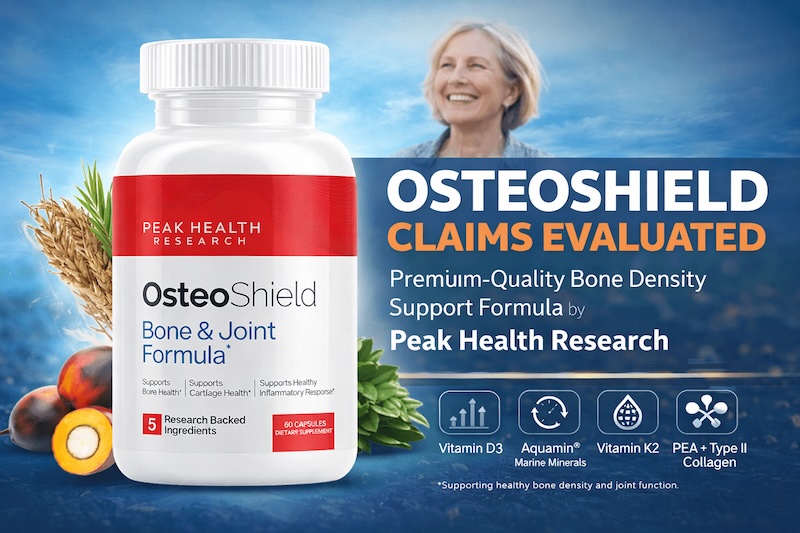
Search interest around terms like "OsteoShield ingredients," "OsteoShield bone density support," and "OsteoShield effectiveness" has increased as consumers look for alternatives to single-ingredient calcium supplements. This report was developed by Peak Health Research to provide clarity on how OsteoShield is formulated, how its ingredients align with published research, and what consumers should verify before considering use — with ingredient-level research context, transparent label analysis, published pricing information, and enough detail for a real conversation with your healthcare provider about whether this formula makes sense for your situation.
OsteoShield is a bone density and joint support supplement formulated around five active compounds: Aquamin (a marine multimineral complex from Icelandic red algae), Palmitoylethanolamide (PEA), Undenatured Type II Collagen (UC-II), Vitamin D3, and Vitamin K2 (MK-7). The formulation is built on a multi-pathway approach — addressing mineral delivery, inflammation modulation, and calcium metabolism simultaneously rather than relying on calcium alone.
What follows is a transparent breakdown of what each ingredient does, what published research supports, where the evidence is strong, and where gaps remain between ingredient-level findings and finished-product clinical proof. This report also covers pricing structure, refund terms, and what to verify before making any purchasing decision.
Current product details, pricing, and terms are available by viewing the current OsteoShield offer on the official Peak Health Research page.
Individual results vary. Dietary supplements are not substitutes for balanced nutrition, regular physical activity, or professional medical guidance. Consult a qualified healthcare provider before starting any new supplement regimen — especially if you are currently taking medications for osteoporosis, bone loss, or any other condition.
What Is OsteoShield
OsteoShield is a dietary supplement formulated for adults over 40 who are looking for bone density and joint support beyond what standard calcium carbonate supplements offer. The product is taken as two capsules daily and is designed to work through multiple pathways — delivering a broad-spectrum mineral matrix, modulating inflammatory signaling, and supporting calcium absorption and proper calcium placement in bone tissue.
OsteoShield is manufactured in the United States in an FDA-registered facility located in Tampa, FL. Customer support is U.S.-based and available by phone and email. The product is sold exclusively through the official website at morningvitality.com.
Each two-capsule serving contains:
Vitamin D3 (cholecalciferol) — 25 mcg (1,000 IU) — 125% Daily Value
Vitamin K2 (menaquinone-7, MK-7) — 45 mcg
Aquamin® Marine Multimineral Complex — 900 mg
Palm-Collagen™ Blend — 340 mg, containing Palmitoylethanolamide (PEA) at 300 mg and Undenatured Collagen Type II at 40 mg
Other ingredients include BSE-free gelatin (capsule), microcrystalline cellulose, silica, and magnesium stearate.
One detail worth highlighting: OsteoShield's Supplement Facts panel discloses the specific dosage of every active ingredient individually. This is not a proprietary blend where ten ingredients share an undisclosed portion of a total weight. Every milligram is accounted for on the label. That matters because it allows you — and your healthcare provider — to compare each ingredient's dosage directly against published research ranges. In a supplement category where proprietary blends and hidden dosages are the norm, full-disclosure labeling is a meaningful differentiator.
The Formulation Thesis: Why the "Zombie Cell" Framework Matters
The OsteoShield formulation is built around a specific thesis about why conventional calcium supplementation often falls short for adults experiencing age-related bone density decline. That thesis centers on what published research calls cellular senescence — and what this report describes in consumer-accessible terms as "zombie cell inflammation."
Here's the concept in plain language. As you age, certain cells in your body stop dividing but don't die. They linger in tissues — including bone tissue — and release a constant stream of inflammatory compounds. Researchers call this the Senescence-Associated Secretory Phenotype (SASP). Published studies from institutions including the Mayo Clinic, the Buck Institute for Research on Aging, and Johns Hopkins have documented how this inflammatory signaling can disrupt the bone remodeling cycle — the carefully balanced process where old bone is broken down by osteoclasts and new bone is built by osteoblasts.
When that balance tips toward breakdown, bone density declines. And the research suggests that this inflammatory disruption is one reason why simply adding more calcium — without addressing the inflammatory environment — may not be enough on its own. This report aligns its analysis with published research frameworks from institutions studying bone metabolism and age-related cellular changes.
The OsteoShield formulation addresses this by combining three distinct functional pathways in a single daily serving:
Pathway 1 — Inflammation modulation: Palmitoylethanolamide (PEA) targets inflammatory signaling through PPAR-alpha receptor activation and mast cell modulation, which published research has linked to reductions in the kind of chronic, low-grade inflammation associated with cellular senescence in joint and bone tissue.
Pathway 2 — Immune rebalancing: Undenatured Type II Collagen (UC-II) works through a mechanism called oral tolerance — training the immune system to reduce its inflammatory attacks on cartilage and the structural bone beneath it.
Pathway 3 — Full-spectrum mineral delivery: Aquamin delivers plant-based calcium along with more than 70 trace minerals in a natural marine matrix, paired with Vitamin D3 to support calcium absorption and Vitamin K2 (MK-7) to activate the proteins that direct calcium into bone rather than soft tissues.
This multi-pathway approach is the core differentiator. Most bone supplements deliver calcium — sometimes with D3. OsteoShield's formulation targets the inflammatory environment, the immune signaling, and the mineral delivery simultaneously.
That said, transparency requires noting an important distinction. The underlying biological concepts — cellular senescence, SASP, and their effects on bone metabolism — are well-documented in published peer-reviewed research. The specific term "zombie cell inflammation" is a consumer-facing framework, not a standardized medical diagnosis. And while the individual ingredients in this formula have published research supporting their mechanisms, no independent clinical trial has evaluated OsteoShield as a finished multi-ingredient formula. The multi-pathway thesis is supported by ingredient-level evidence, not finished-product clinical proof.
Ingredient Research Context: What Published Studies Support
Because OsteoShield uses full-disclosure labeling, you can compare every ingredient and dosage against what published research has actually tested. Here's what the evidence looks like for each active component:
Aquamin® Marine Multimineral Complex — 900 mg
Aquamin is a branded ingredient derived from the calcified skeletal remains of the red algae species Lithothamnion, harvested from the pristine waters off the coast of Iceland. It contains approximately 12% calcium, 1% magnesium, and measurable levels of more than 70 additional trace minerals — including zinc, strontium, manganese, and selenium — all naturally occurring within the algae's mineral matrix.
This is fundamentally different from the calcium carbonate found in most drugstore supplements. Calcium carbonate is extracted from limestone — it delivers calcium in isolation. Aquamin delivers calcium as part of a broad-spectrum mineral complex in a form that published research suggests may be more readily utilized by bone-building cells.
The published research on Aquamin relevant to bone health includes several notable findings. In an animal model of osteoporosis published in Calcified Tissue International, Aquamin supplementation helped preserve bone structure and slowed bone mineral density loss more effectively than standard calcium carbonate when calcium levels were equalized between groups. A study published in the Journal of Bone and Mineral Metabolism found that Aquamin preserved bone structure and function in mice on a high-fat Western-style diet — and notably, bone structure in the supplemented group was superior even to the control group on a standard diet. In vitro research demonstrated that Aquamin promoted increased mineralization in osteoblast cell cultures, with researchers theorizing that the synergistic effect of the full mineral complex was responsible for the increased bone formation activity. In human clinical trials, Aquamin supplementation was associated with improvements in walking distance and reductions in joint stiffness in subjects with knee osteoarthritis.
The 900 mg dosage in OsteoShield is within the range used in several of these published studies. This is ingredient-level research — these studies examined Aquamin as a standalone ingredient or compared it against specific controls, not as part of the OsteoShield multi-ingredient formula. But the dosage alignment between the label and published research conditions is a relevant consideration.
Palmitoylethanolamide / PEA — 300 mg
PEA is an endogenous fatty acid amide — your body produces it naturally — that has been extensively studied for its anti-inflammatory and analgesic properties. It works primarily through PPAR-alpha receptor activation and mast cell modulation, reducing the release of inflammatory mediators including histamine and TNF-alpha.
The published evidence base for PEA is substantial. A 2017 systematic meta-analysis involving data from 786 patients receiving PEA for pain-related conditions found that PEA supplementation was associated with significantly greater pain reduction than observed in control groups. In preclinical osteoarthritis models, PEA reduced inflammatory cytokines and improved subchondral bone structure — the layer of bone directly beneath cartilage that plays a critical role in overall bone integrity. Clinical studies have reported that PEA supplementation reduced pain scores in patients with knee osteoarthritis compared to placebo over 8-week periods. In a 2015 analysis of a double-blind, placebo-controlled study of PEA in sciatic pain, the Number Needed to Treat was 1.5 — a strong clinical result.
Research dosages for PEA in clinical settings typically range from 300 to 1,200 mg daily. The 300 mg dosage in OsteoShield falls at the lower end of this published range. These studies examined PEA as an isolated compound, not as part of the OsteoShield formulation.
Undenatured Type II Collagen / UC-II — 40 mg
UC-II is a form of collagen that retains its native triple-helix molecular structure. Unlike hydrolyzed collagen supplements that provide amino acid building blocks, UC-II works through a mechanism called oral tolerance — essentially training the immune system to reduce its inflammatory response against cartilage tissue and the bone beneath it.
Published research on UC-II has demonstrated reductions in inflammatory mediators associated with joint degradation. The ingredient has been studied in clinical settings at dosages of 40 mg daily — which aligns exactly with the amount on OsteoShield's label. Studies have reported improvements in joint comfort and function compared to both placebo and standard glucosamine-chondroitin combinations.
Vitamin D3 — 25 mcg / 1,000 IU
Vitamin D3 is one of the most extensively studied nutrients in bone health. Its primary role is facilitating calcium absorption in the intestines — without adequate D3, your body cannot effectively use the calcium you consume. The 1,000 IU dosage is within commonly recommended supplemental ranges, though individual needs vary based on baseline vitamin D status, sun exposure, and other factors. A simple blood test can determine whether this dosage is appropriate for your specific situation.
Vitamin K2 as MK-7 — 45 mcg
Vitamin K2 in the MK-7 form activates osteocalcin — the protein that helps bind calcium into bone matrix rather than allowing it to deposit in soft tissues like arteries. The MK-7 form has a longer half-life than other K2 variants, which may support more sustained activity throughout the day.
Important note: Vitamin K2 can interact with blood-thinning medications such as warfarin. If you are taking anticoagulant medications, consult your healthcare provider before using any supplement containing Vitamin K.
Understanding What Has and Has Not Been Proven
This is one of the most important sections for anyone doing their due diligence — and it applies to the entire supplement category, not just OsteoShield.
For any dietary supplement to demonstrate effectiveness through clinical evidence, the gold standard is a randomized, placebo-controlled trial using the finished product at its actual dosage. That study would need to disclose the exact formulation, specify the duration of use, define measurable endpoints like DEXA scan bone mineral density changes, and enroll a population representative of the target consumer. Results would be published in a peer-reviewed journal and subject to independent scrutiny.
As of this writing, no published clinical trial has evaluated OsteoShield as a finished proprietary formula using that standard. The evidence supporting this formula comes from ingredient-level research — some conducted in human clinical trials, some in animal models, some in laboratory cell cultures. That is common across the supplement industry, but it means the gap between ingredient-level research and finished-product clinical proof remains open.
What OsteoShield does offer that many competitors do not is full-disclosure labeling at dosages that can be meaningfully compared to published research. The Aquamin dosage (900 mg) and UC-II dosage (40 mg) are within ranges used in published studies. The PEA dosage (300 mg) falls at the lower end of published clinical ranges. That transparency is part of the product's value proposition — it gives you and your healthcare provider the information needed to make an informed evaluation rather than guessing what's inside a proprietary blend.
Who OsteoShield May Be Right For
OsteoShield may align well with people who:
Want more than just calcium: If you've been taking standard calcium carbonate supplements and feel like they're not delivering what you need, OsteoShield's multi-pathway approach — combining broad-spectrum marine minerals, anti-inflammatory support, immune modulation, and calcium-directing nutrients — offers a fundamentally different strategy.
Value label transparency: Every active ingredient and its exact dosage are disclosed on the Supplement Facts panel. If being able to verify what you're taking and compare it against published research matters to you, this formula delivers that.
Are interested in addressing inflammation alongside mineral delivery: The inclusion of PEA and UC-II reflects a formulation strategy that targets inflammatory pathways — not just mineral gaps. This approach aligns with emerging research on how chronic low-grade inflammation affects bone remodeling.
Are looking for a complement to — not a replacement for — professional bone health management: OsteoShield is designed to work alongside your existing healthcare plan, not replace it.
Other options may be preferable for people who:
Have been diagnosed with osteoporosis requiring prescription intervention: A T-score below -2.5 typically requires clinical management. Dietary supplements are not substitutes for prescription treatments when medically indicated.
Are taking blood-thinning medications: The Vitamin K2 in this formula can interact with anticoagulants like warfarin. A conversation with your prescribing physician is essential before adding any K2-containing supplement.
Expect guaranteed bone density improvements from any single supplement: No dietary supplement can guarantee DEXA score changes. Individual responses depend on baseline bone density, age, hormonal status, concurrent medications, dietary habits, and physical activity levels.
Questions to ask yourself before purchasing:
Have you discussed bone density supplement options with your healthcare provider? Has your provider reviewed the specific ingredients and dosages in this formula? Are you currently taking any medications that could interact with Vitamin K2 or calcium supplementation? Are your expectations aligned with what ingredient-level research actually supports? Have you reviewed the full refund policy and terms on the official website?
Your answers help determine whether OsteoShield's ingredient profile and formulation approach match your specific health situation and goals.
Pricing and Availability
OsteoShield is offered in multiple package options, with pricing varying by supply size. The 6-bottle option (180-day supply) is listed at approximately $49 per bottle with free shipping. The 3-bottle option (90-day supply) is listed at approximately $59 per bottle with free shipping. The 1-bottle option (30-day supply) is listed at approximately $69 per bottle plus a small shipping fee.
The product ships via USPS Priority Mail from the United States, with same-day fulfillment available on most weekdays and Saturdays. Shipping is currently available within the United States only.
Pricing and availability are subject to change. Verify current terms by viewing the current OsteoShield offer on the official Peak Health Research page.
Refund Policy and 180-Day Guarantee
OsteoShield orders are backed by a 180-day money-back guarantee. The published refund policy provides a 180-day window from the date of receipt to request a return.
The refund process requires contacting customer support before sending items back — returns submitted without prior authorization are not accepted per the published terms. Items should be in original condition and packaging, with proof of purchase. Once a return is approved, a prepaid shipping label is provided with instructions. Refunds are credited to the original payment method, with processing taking up to one week after approval plus additional time depending on the buyer's financial institution.
For complete refund terms and conditions, review the published policy on the official website before purchasing.
Consumer Questions About OsteoShield
What does "zombie cell inflammation" mean?
"Zombie cell inflammation" is a consumer-accessible description of cellular senescence — a biological process where aging cells stop dividing but remain metabolically active and release inflammatory compounds. Published research from institutions including the Mayo Clinic has documented how accumulated senescent cells can disrupt tissue function, including bone remodeling. The OsteoShield formulation includes PEA specifically to target inflammatory signaling associated with this process.
Is OsteoShield FDA approved?
OsteoShield is a dietary supplement. Under current federal regulations, dietary supplements do not require FDA approval before being sold. The FDA does not evaluate supplement efficacy claims. OsteoShield is manufactured in an FDA-registered facility, which means the facility meets FDA manufacturing standards and is subject to inspection. This relates to manufacturing quality, not product approval.
How does OsteoShield differ from prescription osteoporosis medications?
OsteoShield is a dietary supplement — a fundamentally different product category than prescription medications such as bisphosphonates or denosumab (Prolia). Prescription osteoporosis medications have been evaluated through large-scale randomized controlled trials and received FDA approval for specific clinical indications. OsteoShield has not undergone that level of evaluation. These are not equivalent product categories. If you have diagnosed osteoporosis, discuss all treatment decisions — including the potential role of dietary supplements — with your prescribing physician.
Can I verify the ingredient research?
Yes. The ingredient-level studies referenced throughout this report are published in peer-reviewed journals and available through PubMed and relevant journal archives. Search terms including "Aquamin bone density," "palmitoylethanolamide osteoarthritis," and "undenatured type II collagen oral tolerance" will return the relevant published literature. These studies examined individual compounds at specific dosages — not OsteoShield's formula as a finished product.
How long before I might notice changes?
Individual responses to any dietary supplement depend on baseline health, consistency of use, concurrent treatments, dietary factors, and physical activity levels. Some ingredients in this formula — particularly PEA — have published research showing measurable changes within 8-week study periods. Bone density changes detectable via DEXA scan typically require longer timeframes. Any expectations should be discussed with your healthcare provider.
What does "FDA-registered facility" mean?
An FDA-registered facility is a manufacturing location that has registered with the FDA as required by federal law. Registration means the facility is subject to FDA inspection and must follow current Good Manufacturing Practices (cGMP). It does not mean the FDA has reviewed, approved, or endorsed any specific product manufactured there.
Where is OsteoShield sold?
OsteoShield is available exclusively through the official website. It is not sold through Amazon, retail stores, or third-party marketplaces. Product authenticity and refund eligibility may not be guaranteed through unauthorized sellers.
Who makes OsteoShield?
OsteoShield is manufactured and sold by Peak Health Research. The product is manufactured in Tampa, FL. The company operates under Nutra Hero LLC per published terms of service information.
Contact Information
For questions about OsteoShield, ordering, or returns, Peak Health Research customer support is available through the following channels:
Phone: +1 (888) 811-1186
Email: support@peakhealthresearch.com
Product Return Address: ATTN: RETURNS P.O. Box 7000, Smyrna, TN 37167 USA
View current OsteoShield pricing and availability on the official Peak Health Research page
Summary
OsteoShield is a bone density and joint support supplement built on a multi-pathway formulation approach — combining Aquamin (a marine multimineral complex with more than 70 trace minerals), PEA (a well-studied anti-inflammatory compound), UC-II (immune-modulating undenatured collagen), Vitamin D3, and Vitamin K2 (MK-7). The formula uses full-disclosure labeling with individually disclosed ingredient dosages that align with or fall within published research ranges.
The formulation addresses three distinct functional pathways — inflammation modulation, immune rebalancing, and full-spectrum mineral delivery — rather than relying on calcium supplementation alone. Individual ingredients have published preclinical and clinical research supporting their roles in bone and joint health. No published clinical trial has evaluated OsteoShield as a finished multi-ingredient formula, which is common across the dietary supplement category.
The product is backed by a 180-day refund guarantee, U.S.-based customer support, and is manufactured in an FDA-registered facility. Full product details, current pricing, and published terms are available by viewing the current OsteoShield offer on the official Peak Health Research page.
Disclaimers
Content and Consumer Information Disclaimer: This report is an informational overview provided for educational purposes and does not constitute medical, health, dietary, financial, or legal advice. This report reflects information presented by Peak Health Research regarding OsteoShield's formulation, ingredients, and product positioning. Readers are encouraged to verify all details directly with Peak Health Research and to consult a qualified healthcare professional before beginning any dietary supplement.
FDA Health Disclaimer: These statements have not been evaluated by the Food and Drug Administration. This product is not intended to diagnose, treat, cure, or prevent any disease. Always consult your physician before starting any new supplement, especially if you have existing health conditions, take medications, or are pregnant or nursing.
Professional Medical Disclaimer: This report is educational and does not constitute medical advice. OsteoShield is a dietary supplement, not a medication. If you are currently taking medications, have existing health conditions, are pregnant or nursing, or are considering any major changes to your health regimen, consult your physician before starting OsteoShield or any new supplement. Do not change, adjust, or discontinue any medications or prescribed treatments without your physician's guidance and approval.
Ingredient Interaction Warning: OsteoShield contains Vitamin K2 (MK-7), which may interact with blood-thinning medications such as warfarin and other anticoagulants. If you are taking blood thinners, blood pressure medications, diabetes medications, or have any chronic health conditions, consult your healthcare provider before starting this or any supplement.
Results May Vary: Individual results will vary based on factors including age, baseline bone density, hormonal status, lifestyle factors, consistency of use, genetic factors, current medications, concurrent treatments, and other individual variables. Results are not guaranteed. Customer feedback referenced by the company represents individual experiences and should not be interpreted as typical or guaranteed outcomes.
FTC Affiliate Disclosure: This report may contain links that result in compensation to the publisher if a purchase is made. This compensation does not influence the accuracy, neutrality, or integrity of the information presented. Any purchase decisions should be made directly through the official Peak Health Research website after independent verification of current terms.
Pricing Disclaimer: All prices, discounts, and promotional offers mentioned were accurate at the time of publication (April 2026) but are subject to change without notice. Always verify current pricing and terms on the official Peak Health Research website before making a purchase.
Publisher Responsibility Disclaimer: Every effort has been made to ensure accuracy at the time of publication. No responsibility is accepted for errors, omissions, or outcomes resulting from the use of the information provided. Readers are encouraged to verify all details directly with Peak Health Research and their healthcare provider before making decisions.

Phone: +1 (888) 811-1186 Email: support@peakhealthresearch.com

